
Insight
What happens at a hearing test? Step by step guide and how to read your results
Written by Scott Drummond · 12 June 2026 · 8 min read
A hearing test takes about 60 minutes and is painless. See each step, what your audiogram and tympanogram mean, and what happens next, explained by a London audiologist.
Most people who come for a hearing test in Kensington and Chelsea have been thinking about it for a while — often two or three years. The television is a little louder than it used to be, restaurants have become hard work, and someone at home has started to comment. The test itself is straightforward, painless and takes about an hour, and by the end of it you'll have a clear picture of your hearing on paper.
This guide walks through exactly what happens at a diagnostic hearing assessment, and — the part patients ask about most — how to read the results yourself.
Who should have a hearing test?
You don't need a GP referral, and you don't need to be struggling badly. It's worth booking if you:
- Find conversation hard in restaurants, meetings or groups, even though quiet conversation is fine
- Ask people to repeat themselves, or mishear similar-sounding words
- Have the television or phone louder than others find comfortable
- Have tinnitus — ringing, buzzing or hissing in one or both ears
- Have a feeling of blockage or pressure in an ear
- Have worked in noise, or are over 55 and have never had a baseline test
Sudden hearing loss in one ear, or hearing loss with dizziness or pain, should be seen urgently — the same day if possible. If you're still weighing up whether to book, the early signs of hearing loss are worth reading first.
Before you come in
There's very little to prepare. It helps to jot down when you first noticed the change, whether one ear is worse, any history of noise exposure, ear surgery or ear infections, and any medications you take. If a partner or family member has noticed the difference, bring them — their account is genuinely useful, and it helps to have someone else hear the explanation of the results.
What happens during the appointment
1. Your history
We start with a conversation: what you notice, where it's hardest, whether there's tinnitus, and your medical and noise history. This shapes which tests matter most.
2. Video otoscopy
A small camera looks down the ear canal at the eardrum, and the image is shown on screen so you can see it too. This rules out wax, infection or a perforation before any testing begins — and occasionally the whole problem turns out to be a plug of earwax.
3. Pure-tone audiometry — the beeps
In a quiet room you wear headphones and press a button whenever you hear a tone, however faint. Each ear is tested separately across the pitches that matter for speech, from low (250 Hz) to high (8000 Hz). We find the softest level you can hear at each pitch — your threshold.
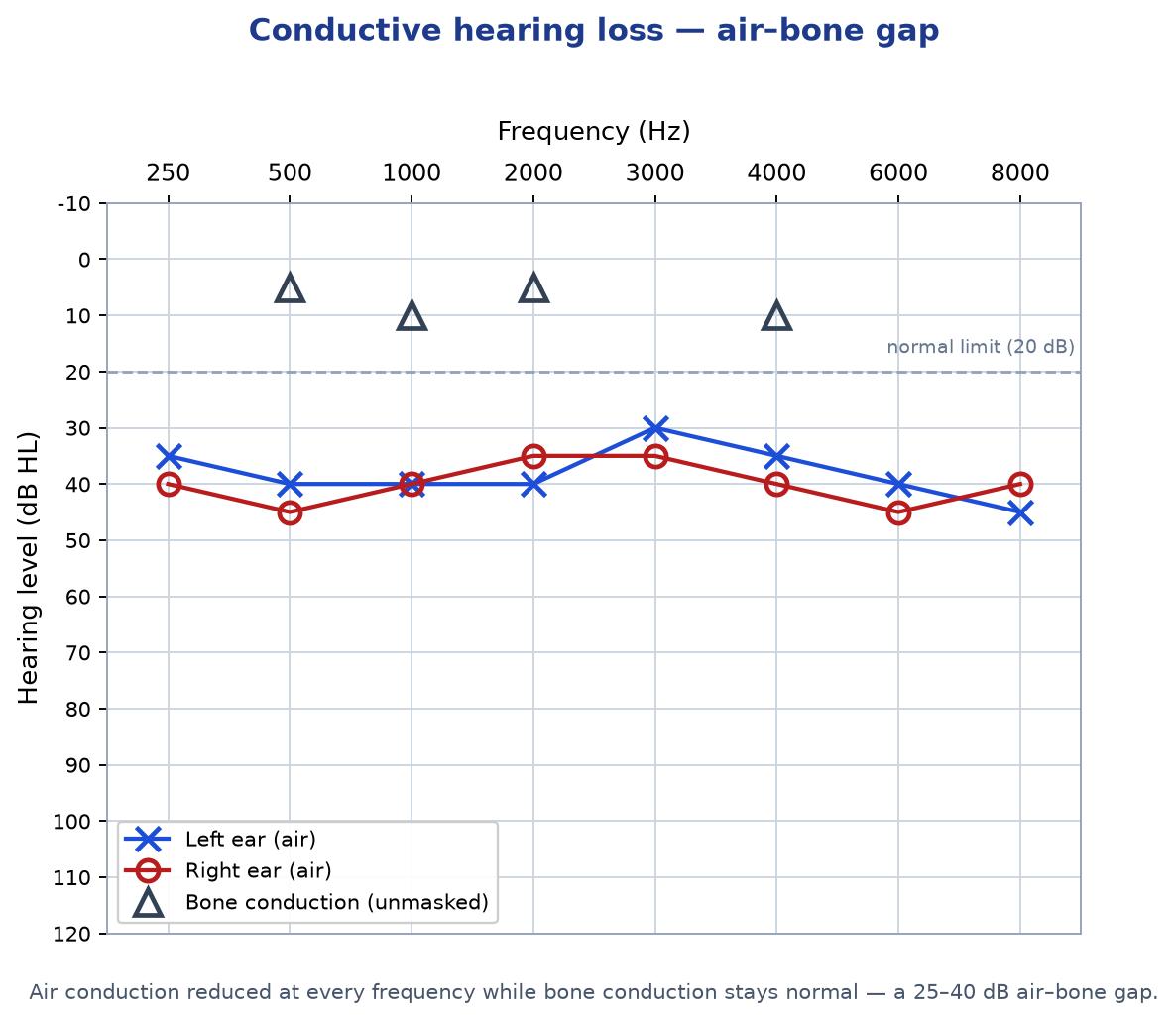
Then the same is done by bone conduction, using a small vibrating headband behind the ear that bypasses the ear canal and middle ear entirely. Comparing the two tells us where the loss is: if bone conduction is normal but air conduction isn't, the problem is mechanical (wax, fluid, middle-ear). If both are reduced together, the loss is in the inner ear or nerve.
4. Tympanometry
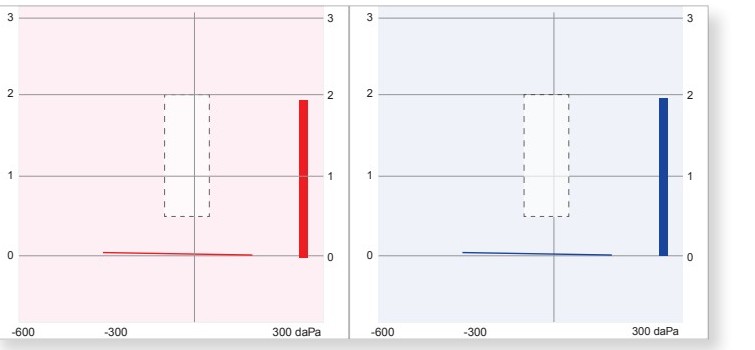
A soft tip in the ear canal changes the air pressure briefly and measures how the eardrum moves. It takes a couple of seconds per ear and feels like a mild pop. This is how we detect fluid behind the eardrum, a blocked Eustachian tube or a perforation.
5. Speech testing, where relevant
Beeps measure sensitivity; speech testing measures usefulness. Repeating back words at different levels — sometimes with background noise — shows how much of the difficulty is clarity rather than volume, and it's a strong predictor of how well hearing aids will help.
How to read your audiogram
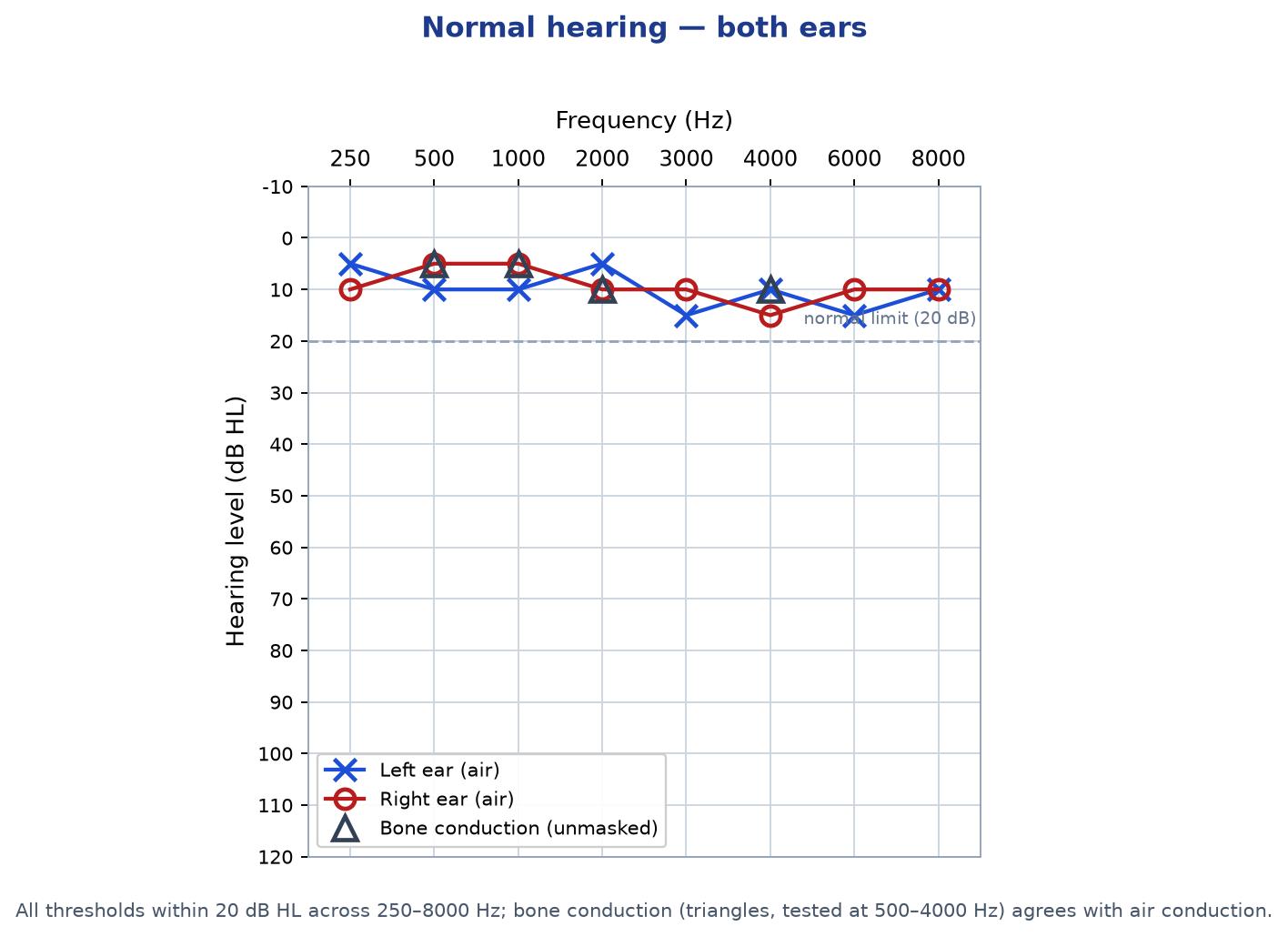
The audiogram is the graph of your results. It looks technical, but there are only two axes to understand:
- Left to right = pitch (frequency), in hertz. Low, deep sounds on the left; high sounds — consonants, birdsong, a smoke alarm — on the right.
- Top to bottom = loudness, in decibels hearing level (dB HL). Counter-intuitively, the graph runs downwards: the further down the mark, the louder a sound has to be before you hear it, and the poorer the hearing.
By convention, the right ear is red and marked with circles (O), and the left ear is blue and marked with crosses (X). Unmasked bone conduction results are shown as triangles (Δ), and are usually measured at 500, 1000, 2000 and 4000 Hz only.
What the numbers mean
Audiologists describe the degree of loss using the average of your thresholds:
- 0–20 dB — normal. No hearing difficulty expected in everyday life.
- 21–40 dB — mild. Quiet speech and group conversation become effortful; most people first notice it in restaurants.
- 41–70 dB — moderate. Normal conversation is difficult without help; hearing aids make a substantial difference.
- 71–90 dB — severe. Only loud speech is heard unaided; powerful hearing aids are needed.
- Over 90 dB — profound. Hearing aids may help, and cochlear implantation is often discussed.
The shape matters as much as the depth
Age-related and noise-related hearing loss typically produces a "ski slope": normal thresholds in the low frequencies falling away sharply in the highs. That shape explains the most common complaint I hear — "I can hear people, I just can't make out what they're saying." Vowels are low-pitched and carry the volume; consonants like s, f, th and t are high-pitched and carry the meaning. Lose the highs and speech is still audible, but blurred, and background noise finishes the job.
What your tympanogram means
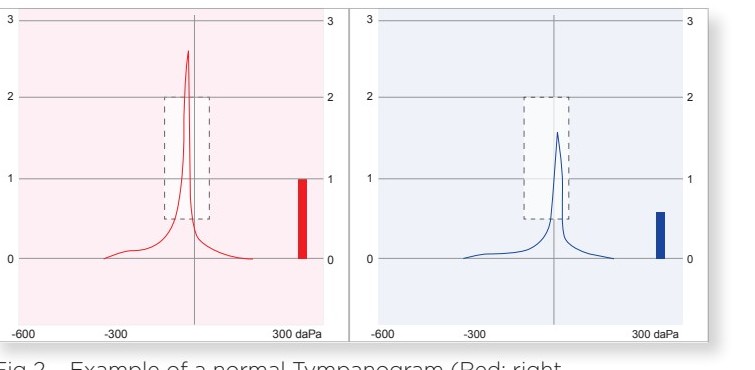
The tympanogram is a second, simpler graph — a single peak. A healthy middle ear gives a clear peak close to zero pressure, showing the eardrum is moving freely.
What happens after the test
You'll be shown your results on screen and given a copy to take away. There are broadly four outcomes:
- Hearing is normal. We keep the audiogram as your baseline and suggest when to re-test. If you still struggle in noise, that's worth investigating in its own right.
- Wax or a temporary blockage. Usually resolved on the day with microsuction, then re-tested.
- A medical finding. Asymmetry between ears, an air–bone gap or sudden loss prompts a referral to an ENT colleague — straightforward to arrange from the Bupa Cromwell Hospital.
- Hearing loss suited to hearing aids. We discuss the options honestly, and nothing is fitted on the day of the test.
If hearing aids are the right answer, you can read about the brands compared and see full pricing before you decide.
Hearing tests in Kensington and Chelsea
Drummond Hearing runs hearing assessments at two locations in the borough and just beyond it:
- Bupa Cromwell Hospital — 164–178 Cromwell Road, Kensington, London SW5 0TU. A few minutes from Gloucester Road and Earl's Court, and recognised by the major insurers. See the Kensington clinic page for directions and parking.
- Visit Health — 1 Blythe Road, London W14 0HG, close to Kensington Olympia.
Every appointment is with Scott Drummond personally — BSc Audiology, HCPC and RCCP registered, and Head of Audiology at the Bupa Cromwell Hospital since 2010. You can see everything included on the services page.
Common questions
- How long does a hearing test take?
- A full diagnostic hearing assessment at Drummond Hearing takes about 60 minutes, including your history, video otoscopy, pure-tone audiometry, tympanometry and a full explanation of the results.
- Does a hearing test hurt?
- No. Nothing sharp or uncomfortable is used. Tympanometry involves a brief change in air pressure in the ear canal that feels a little like a small pop, and lasts a couple of seconds per ear.
- Do I need a GP referral for a private hearing test?
- No. You can book directly with Drummond Hearing at the Bupa Cromwell Hospital in Kensington or at Visit Health on Blythe Road.
- How much does a private hearing test cost in London?
- £150 for a 60-minute initial consultation, which includes video otoscopy, pure-tone audiometry, tympanometry and a written copy of your results.
- How often should I have my hearing tested?
- Every two years from the age of 55, or annually if you already wear hearing aids, work in noise, or have noticed a change in your hearing or tinnitus.
Book a hearing test in Kensington
A full 60-minute diagnostic assessment with video otoscopy, audiometry and tympanometry — results explained in plain language, with a copy to take home. No GP referral needed.
We see patients for hearing tests from South Kensington, Chelsea and Kensington, plus every area we cover.
Book an appointmentThis article is for general information and isn't a substitute for individual medical advice.